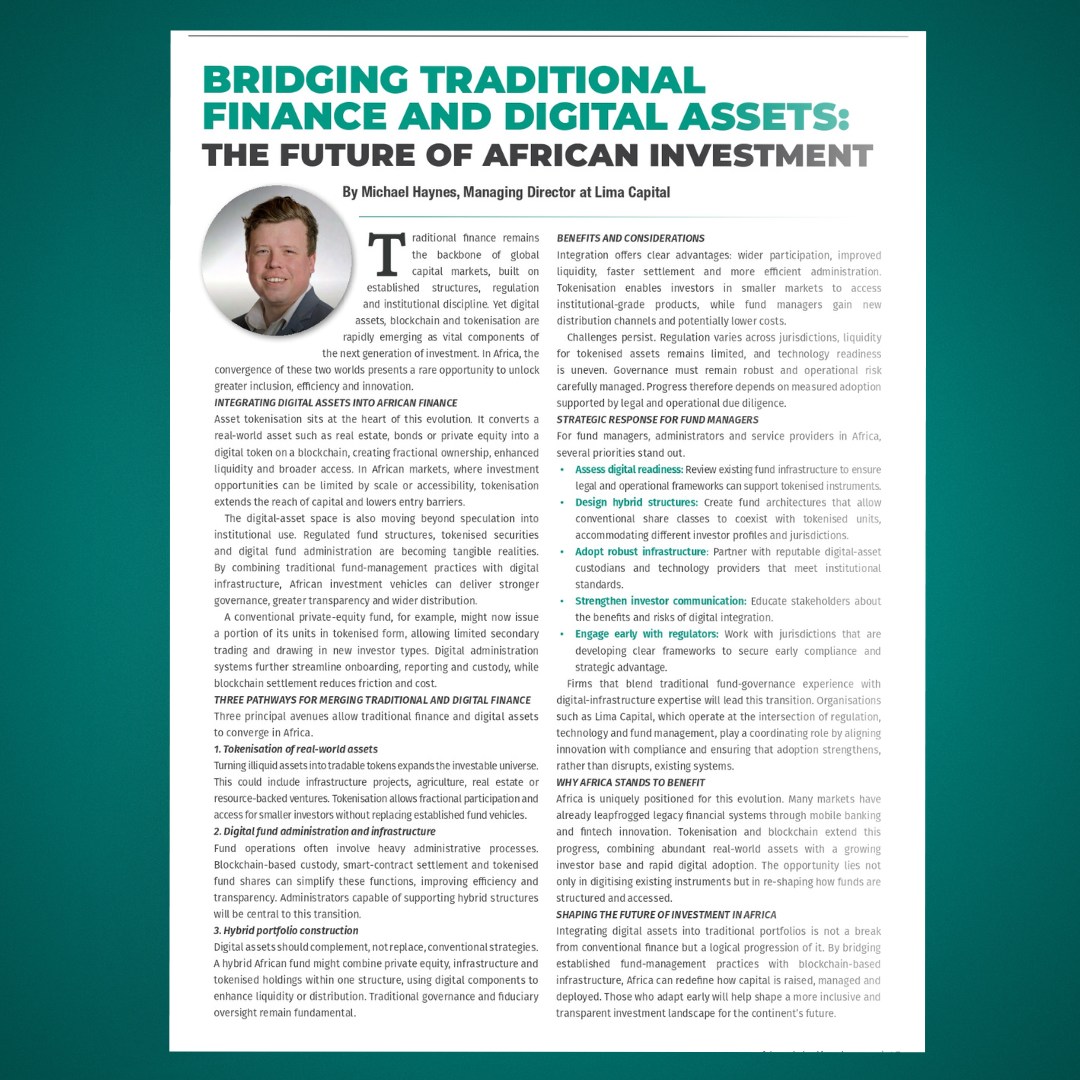
Featured in the November 2025 edition of Africa Global Funds magazine. Traditional finance remains the backbone of global capital markets, built on established structures, regulation and institutional discipline. Yet digital assets, blockchain and tokenisation are rapidly emerging as vital components of the next generation of investment. In Africa, the convergence of these two worlds presents a rare opportunity to unlock greater inclusion, efficiency and innovation.
Integrating digital assets into African finance
Asset tokenisation sits at the heart of this evolution. It converts a real-world asset such as real estate, bonds or private equity into a digital token on a blockchain, creating fractional ownership, enhanced liquidity and broader access. In African markets, where investment opportunities can be limited by scale or accessibility, tokenisation extends the reach of capital and lowers entry barriers.
The digital-asset space is also moving beyond speculation into institutional use. Regulated fund structures, tokenised securities and digital fund administration are becoming tangible realities. By combining traditional fund-management practices with digital infrastructure, African investment vehicles can deliver stronger governance, greater transparency and wider distribution.
A conventional private-equity fund, for example, might now issue a portion of its units in tokenised form, allowing limited secondary trading and drawing in new investor types. Digital administration systems further streamline onboarding, reporting and custody, while blockchain settlement reduces friction and cost.
Three pathways for merging traditional and digital finance
Three principal avenues allow traditional finance and digital assets to converge in Africa:
-
Tokenisation of real-world assets
Turning illiquid assets into tradable tokens expands the investable universe. This could include infrastructure projects, agriculture, real estate or resource-backed ventures. Tokenisation allows fractional participation and access for smaller investors without replacing established fund vehicles. -
Digital fund administration and infrastructure
Fund operations often involve heavy administrative processes. Blockchain-based custody, smart-contract settlement and tokenised fund shares can simplify these functions, improving efficiency and transparency. Administrators capable of supporting hybrid structures will be central to this transition. -
Hybrid portfolio construction
Digital assets should complement, not replace, conventional strategies. A hybrid African fund might combine private equity, infrastructure and tokenised holdings within one structure, using digital components to enhance liquidity or distribution. Traditional governance and fiduciary oversight remain fundamental.
Benefits and considerations
Integration offers clear advantages: wider participation, improved liquidity, faster settlement and more efficient administration. Tokenisation enables investors in smaller markets to access institutional-grade products, while fund managers gain new distribution channels and potentially lower costs.
Challenges persist. Regulation varies across jurisdictions, liquidity for tokenised assets remains limited, and technology readiness is uneven. Governance must remain robust and operational risk carefully managed. Progress therefore depends on measured adoption supported by legal and operational due diligence.
Strategic response for fund managers
For fund managers, administrators and service providers in Africa, several priorities stand out:
-
Assess digital readiness: Review existing fund infrastructure to ensure legal and operational frameworks can support tokenised instruments.
-
Design hybrid structures: Create fund architectures that allow conventional share classes to coexist with tokenised units, accommodating different investor profiles and jurisdictions.
-
Adopt robust infrastructure: Partner with reputable digital-asset custodians and technology providers that meet institutional standards.
-
Strengthen investor communication: Educate stakeholders about the benefits and risks of digital integration.
-
Engage early with regulators: Work with jurisdictions that are developing clear frameworks to secure early compliance and strategic advantage.
Firms that blend traditional fund-governance experience with digital-infrastructure expertise will lead this transition. Organisations such as Lima Capital, which operate at the intersection of regulation, technology and fund management, play a coordinating role by aligning innovation with compliance and ensuring that adoption strengthens, rather than disrupts, existing systems.
Why Africa stands to benefit
Africa is uniquely positioned for this evolution. Many markets have already leapfrogged legacy financial systems through mobile banking and fintech innovation. Tokenisation and blockchain extend this progress, combining abundant real-world assets with a growing investor base and rapid digital adoption. The opportunity lies not only in digitising existing instruments but in reshaping how funds are structured and accessed.
Shaping the future of investment in Africa
Integrating digital assets into traditional portfolios is not a break from conventional finance but a logical progression of it. By bridging established fund-management practices with blockchain-based infrastructure, Africa can redefine how capital is raised, managed and deployed. Those who adapt early will help shape a more inclusive and transparent investment landscape for the continent’s future.